
Anisotropic, temperature-dependent material modeling in mold filling simulation with fluid-structure interaction of sandwich components in RTM
- chair:Anisotropic, temperature-dependent material modeling in mold filling simulation with fluid-structure interaction of sandwich components in RTM
- type:Thesis
- time:By arrangement
- tutor:
Anisotropic, temperature-dependent material modeling in mold filling simulation with fluid-structure interaction of sandwich components in RTM
Motivation
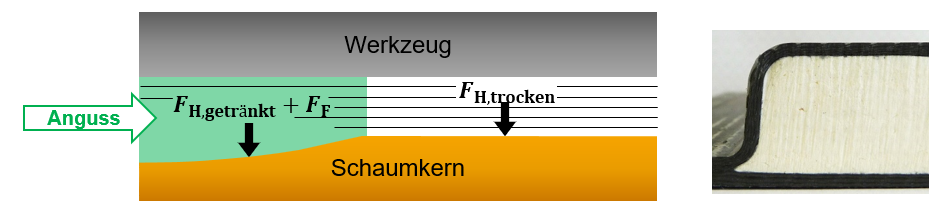
To make the production of fiber-reinforced plastics as resource-efficient as possible, it is essential to design not only the structural behavior but also the manufacturing process itself as precisely as possible, thereby reducing material consumption. Sandwich composites with an integrated foam core can be manufactured in a single process step, for example, using Resin Transfer Molding (RTM). In this process, dry fiber preforms are infiltrated with a plastic resin under pressure in a closed, near-net-shape mold. A major challenge lies in the reciprocal influence of fluid pressure on the deformation of the foam core and the fiber preform, and the resulting changes in the fluid zone. These changes are modeled in the mold filling simulation using fluid-structure interaction. The compaction behavior and permeability of the fiber preform, the stiffness of the foam core, and the viscosity of the infiltrating resin have a significant impact on this interaction. Accurately capturing, modeling, and coupling these temperature-, time-, and direction-dependent material properties presents a significant challenge. To represent this complex material behavior, existing anisotropic, hyperelastic, or viscoelastic material models will be further developed within the scope of this work.
Content
- Review of the relevant state of research
- Development of methods for describing material behavior
- Implementation of the developed methods
- Verification of the approach
- Evaluation and documentation of the findings
Requirements:
- Motivation and independent work style
- Prior knowledge/interest in fluid mechanics or continuum mechanics
- Prior programming knowledge, especially in C++ or Fortran, is advantageous
- Prior experience with OpenFOAM or Abaqus/CalculiX is advantageous
Field of study: Mechanical engineering or related fields
Type of work: Simulation
Start date: To be agreed upon
Contact
Tel. +49 721 608-41816
E-Mail: sarah.schlegel∂kit.edu