News 2026
Presentation of SenseKIT at the IEEE GECon in Ilmenau
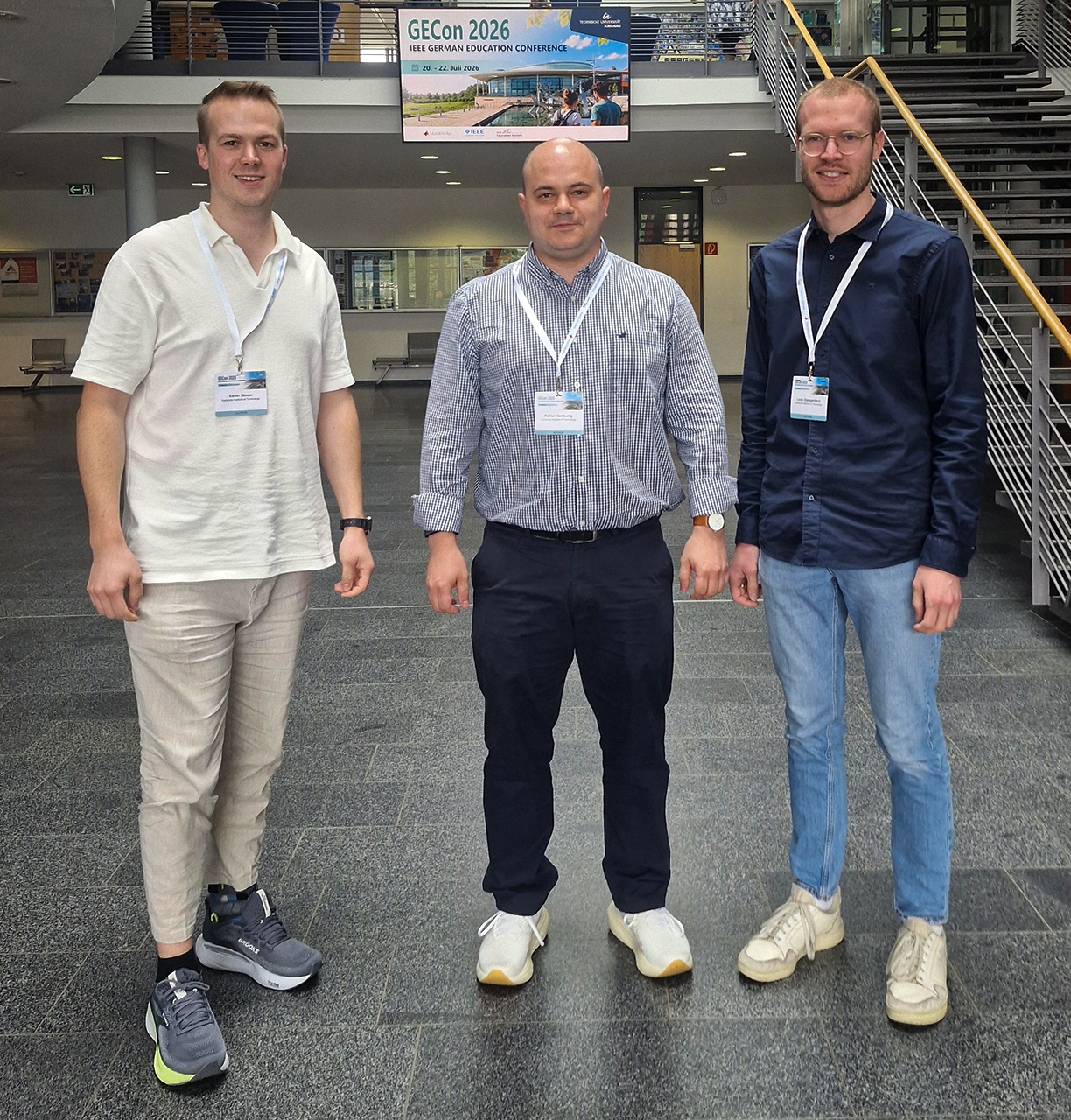
On July 20, 2026, Fabian Gottselig, Leon Stangenberg and Kevin Simon from FAST presented their paper “SenseKIT: A Modular Mobile Sensor Platform for Autonomous Driving Education” at the IEEE German Education Conference (GECon) in Ilmenau.
As part of their presentation, they shared the latest research findings on the SenseKIT sensor platform and provided insights into the associated teaching and educational concepts. In addition to technical aspects, they focused in particular on approaches designed to introduce students, high school students, and the interested public to topics related to autonomous driving.
The development of the sensor platform was supported by the “Mobile Research Laboratories” funding program of the Innovation Campus for Mobility of the Future (ICM). SenseKIT is characterized by the use of full-scale hardware—including sensors, computing, and power supply components—while maintaining compact dimensions. This makes the platform particularly well-suited for use in university courses as well as in school learning environments.
The subsequent expert discussions provided an opportunity to exchange ideas with researchers and faculty members in the field of higher education pedagogy and led to initial ideas for future collaborations. There was particular interest in concepts for integrating and utilizing generative AI in teaching and training, which provided valuable insights for the further development of existing educational programs.
Doctoral Defense of Meng Zhang, M.Sc.
July 2, 2026: The Automotive Engineering Division congratulates Mr. Meng Zhang, M.Sc., on passing his doctoral defense.
TRFMU Presentation at chassis.tech plus 2026
On June 24, 2026, Timon Schlögl presented at the 17th International Munich Chassis Symposium (chassis.tech plus 2026), a newly developed measurement trailer built as part of the “AI-Based Vehicle Performance and Road Condition Prediction” project.
The trailer, also known as the “Tire Road Friction Measurement Unit,” is road-approved and enables the measurement of traction behavior between tires and the road surface on a wide variety of road surfaces throughout Germany. In combination with the towing vehicle, which is equipped with additional sensors, the collected data serves as training data for an AI system that predicts traction potential on the upcoming section of road based on camera and LIDAR data.
Significant interest was already evident during the subsequent discussion and conversations held during breaks, leading to the scheduling of initial follow-up exchanges with partners from research and industry.

Modular vehicle concept U-Shift II introduced
FAST staff, together with other researchers from Baden-Württemberg, have further developed U-Shift II, a driverless, modular vehicle concept: An autonomous platform can accommodate different capsules as needed—for example, for passenger transport, delivery services, or mobile services. This allows a single vehicle to be used flexibly for multiple applications.
The prototype vehicle was unveiled at the project’s closing event on June 18, 2026, at the KIT Campus East. The goal was to make mobility more efficient and sustainable. At the heart of the system is an autonomous “Driveboard” that independently picks up and docks the capsules.
The project involved FAST and the ITIV at KIT, the DLR, the Institute for Measurement, Control, and Microtechnology at the University of Ulm and the FKFS. The state of Baden-Württemberg provided a total of 10 million euros in funding for U-Shift II.
As part of the project, FAST was responsible for developing and building the Driveboard’s chassis and also integrated the lifting mechanism required for automated capsule changes. In addition, a patented steering gear was developed that allows for both in-phase and out-of-phase wheel steering, thereby enabling increased maneuverability. Furthermore, an additively manufactured variant of the chassis was developed that incorporates cables carrying materials, energy, and data within the forks, thereby reducing material usage.
Detailed information:
Today a shuttle, tomorrow a delivery vehicle: One vehicle, many functions | KIT
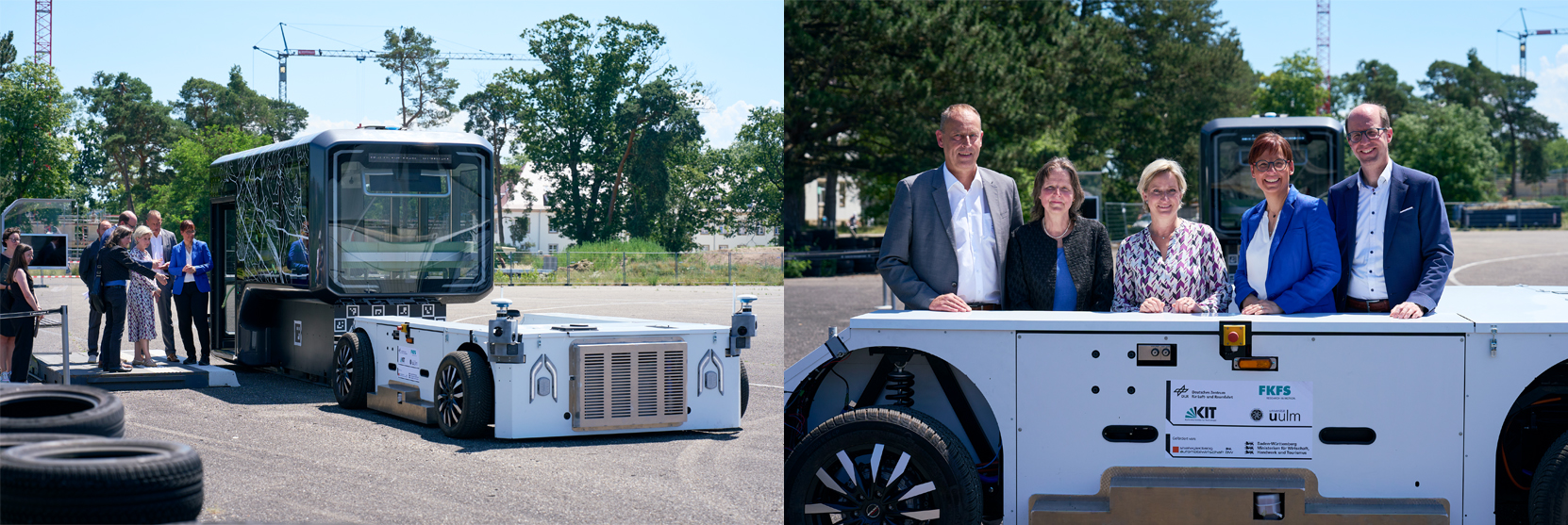
(Ministry of Economic Affairs, Labor, and Tourism of Baden-Württemberg), Prof. Meike Jipp (DLR), Prof. Michael Buchholz (University of Ulm).
Successful milestone presentation in the “SimVorbeifahrt II” project
On May 21, 2026, the project team presented the results achieved to date to representatives from industry. As part of the project, researchers from the Chair of Thermodynamics of Mobile Energy Conversion Systems at RWTH Aachen University and the KIT Institutes of Product Engineering and Vehicle Systems Technology are collaborating on the development of a methodological guide for simulating noise emissions during accelerated pass-by tests.
The target of the project is to combine simulation methods with experimental noise measurements on a tire test stand. This approach aims to enable a valid assessment of pass-by noise early in the vehicle development process with reduced effort.
During the milestone meeting at KIT’s Institute of Vehicle Systems Technology, the industry partners were briefed on the current status of preparations for vehicle and tire test bench measurements. Among other things, initial simulation results served as the basis for this briefing. The technical exchange was further enriched by tours of the acoustic roller test bench and the “large tire inner drum test bench.”
Industry representatives gave the project’s progress to date a consistently positive assessment. The meeting was thus successfully concluded; a follow-up meeting for further coordination has already been scheduled.

Ph.D. Defense: Muhammed Alhanouti, M.Sc.
April 16, 2026: The Department of Automotive Engineering congratulates Mr. Muhammed Alhanouti, M.Sc., on successfully defending his Ph.D. thesis.

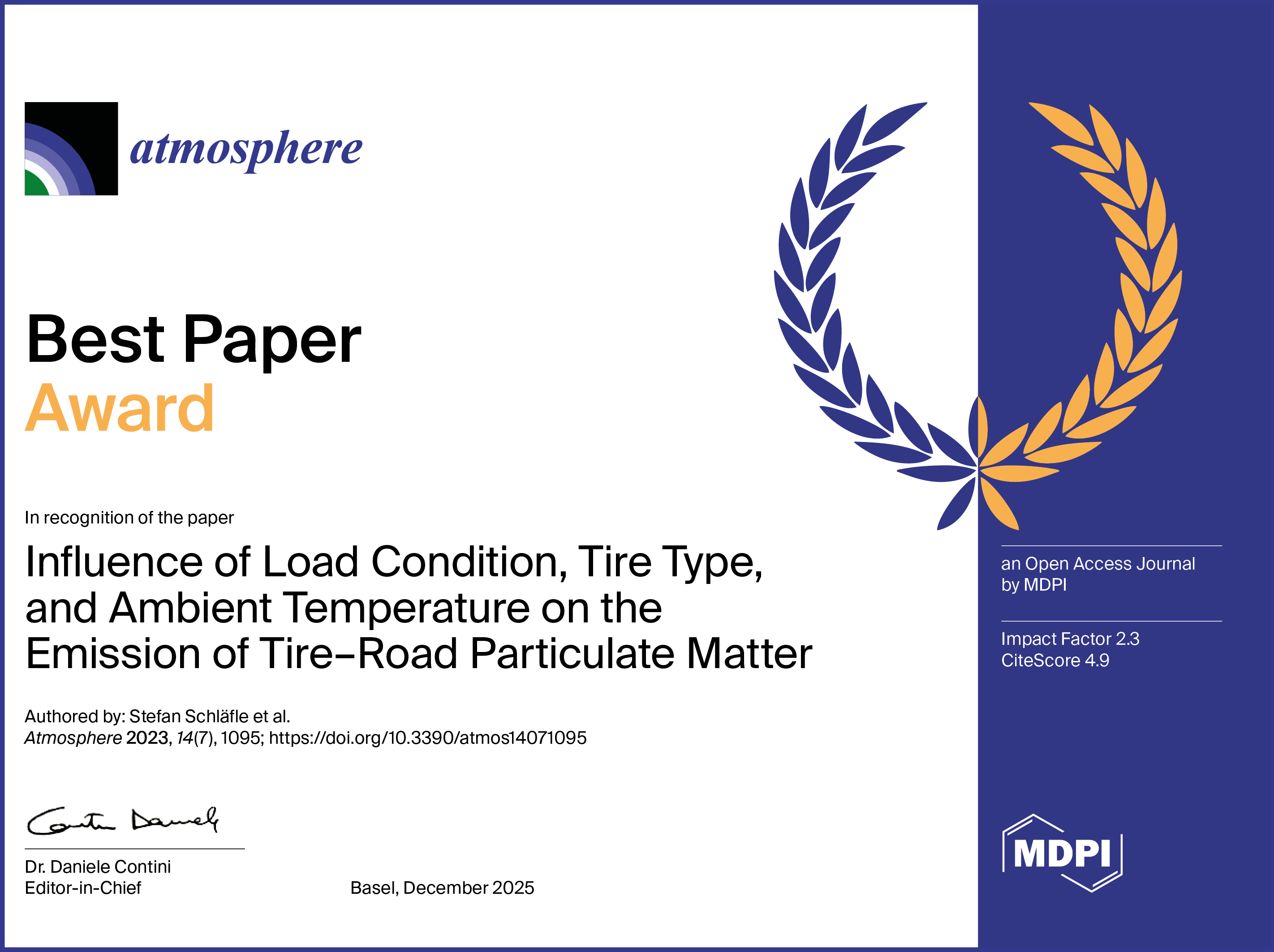
Best Paper Award for a publication from FAST
A publication from the Institute of Vehicle Systems Technology (FAST), Department of Automotive Engineering at KIT, received the Best Paper Award. Stefan Schläfle, Hans-Joachim Unrau, and Frank Gauterin received the award for the paper “Influence of Load Condition, Tire Type, and Ambient Temperature on the Emission of Tire–Road Particulate Matter”, which was published in atmosphere (MDPI).
The study examines particle emissions resulting from tire-road contact under various load, tire, and temperature conditions. The findings provide valuable insights into the characterization and quantification of non-combustion emissions—a key topic for future emissions and environmental analyses.
The atmosphere Best Paper Award annually recognizes outstanding publications of high scientific quality, significance, and impact. The selection is made by an international award committee based on the originality, scientific merit, and relevance of the contribution. The award underscores the excellent research work at FAST and its contribution to the further development of modern vehicle systems.
We congratulate Stefan Schläfle, Hans-Joachim Unrau and Frank Gauterin on this international recognition!